
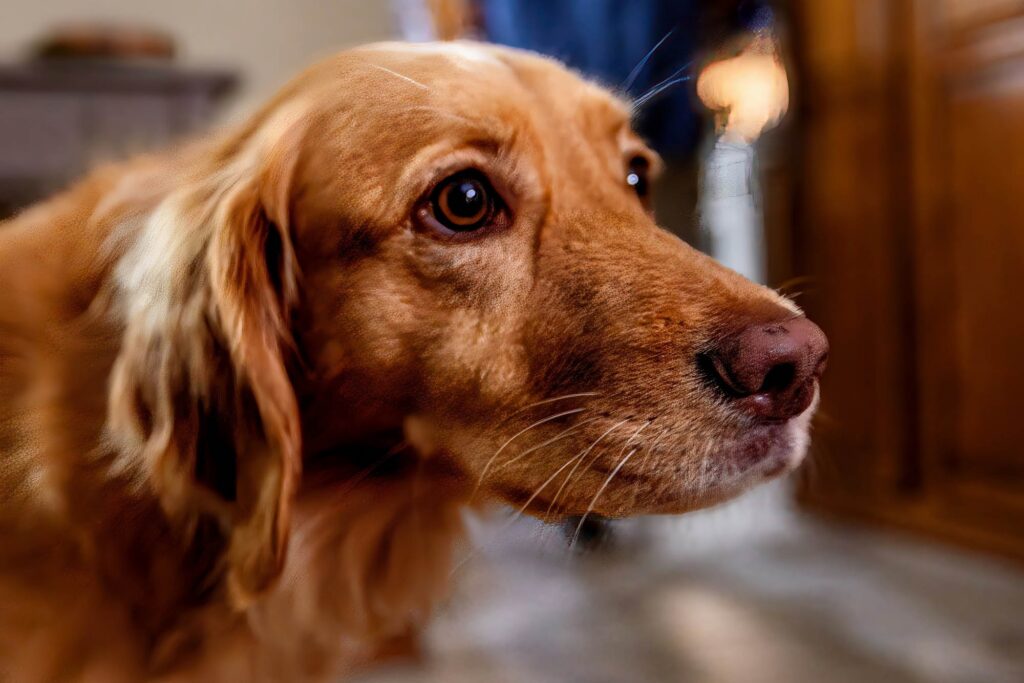
How to take better photos of your dog with your phone
Your phone is a good camera. Most of what separates a fine dog photo from a blurry one is light, height and timing, and all three are free.
Start with the light, not the dog
Every phone photo lives on its light, and the light in most living rooms is the worst kind: a ceiling fixture straight overhead. It puts a shadow under the brow, flattens the coat and turns the eyes into two dark holes. Turn it off.
Find the biggest window in the house and put your dog beside it, not in front of it. Light coming across the face from one side shows the texture of the coat, the wet edge of the nose and the shape of the skull. From behind, the same window turns the dog into a silhouette and the window into a white blob. Morning on an east window, late afternoon on a west one, overcast days on any of them.
Kill the overheads
Lamps and ceiling lights are warm orange; window light is cool blue. Mixed together, the coat goes muddy. One source, and the phone can set its own white balance without guessing.
Move the bed
A dog lies where the bed is. Put the bed in the window light and wait ten minutes.
Black dogs and white dogs
A black coat needs more light than you think; a white one needs less. Slide the exposure down for the white dog so the fur keeps its detail, and up for the black dog so you can find the eyes.
Get down. All the way down.
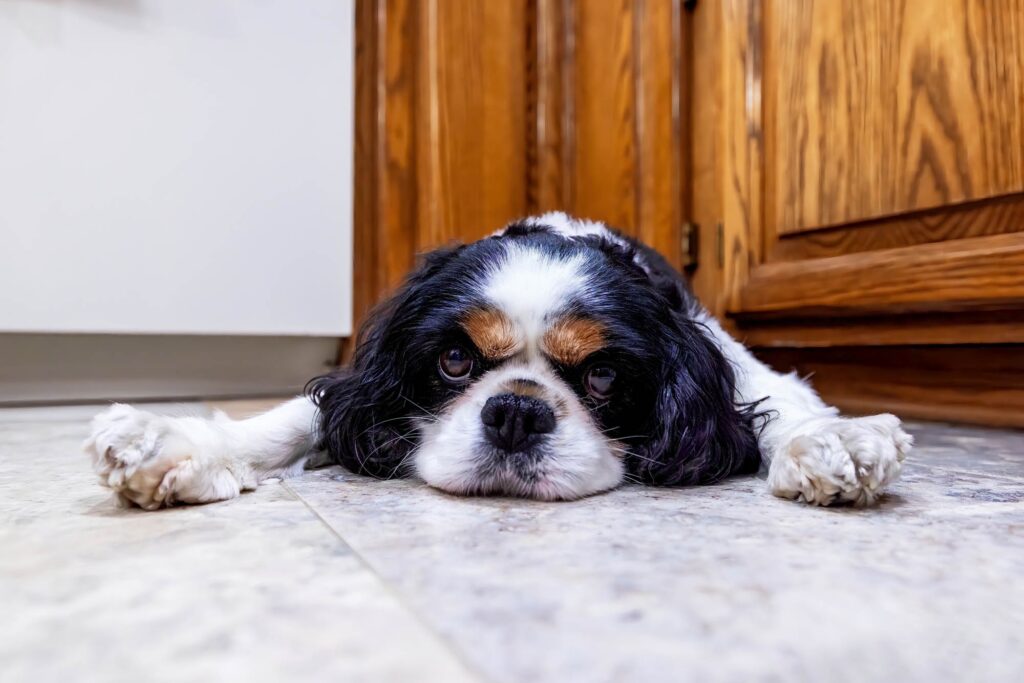
The biggest change you can make costs nothing: get the phone to the dog’s eye level. Standing over a dog gives you the top of a head and a foreshortened body, the view you already have every day. Lying on the kitchen floor gives you a portrait.
Rest the phone on the floor if you have to. Lie on your stomach. For a small dog, that means the lens is an inch off the tile. Your knees will complain; the photo will not.
Tap the eye
A phone focuses on whatever it decides is the subject, and on a dog that is often the nose, because the nose is closest. Tap the screen on the eye nearest you. Then, on most phones, slide your finger up or down to brighten or darken before you shoot.
Look for the catchlight, the small bright reflection of the window in the eye. A photo with catchlights reads as alive. One without reads as a stuffed animal, even when the dog is your dog.
Hold the shutter down
Dogs blink, yawn, shake and turn away in the half second between you seeing the shot and the phone taking it. Hold the shutter button (or slide it, depending on the phone) and take twenty frames instead of one. Pick the best one later and delete the rest.
Burst mode is also the answer for anything that moves: the shake after a bath, the head tilt, the jump for the ball. One frame of a moving dog is luck. Twenty is a plan.
The squeak, the treat, the timing
Ears forward is the whole game. A dog with ears back or flat looks like it wants to leave; ears up and forward looks like the dog is listening to you, which it is. Three tools, and each one has a shelf life.
One squeak, not ten
A squeaky toy, a kissing noise, a crinkled bag. Make the sound once, right after you start the burst. The ears come up for about a second, and then the dog decides the noise is boring. You get two or three good tries per sound before it stops working. Change sounds.
Treat above the lens
Hold a treat an inch above the phone. The dog looks at the treat, which means straight down the lens. A second person holding it frees your hands. Pay the dog after the shot, every time, or the trick stops working.
Say the word once
“Walk,” “car,” whatever the loaded word is in your house. Use it once. Overused, it becomes background noise, and worse, it becomes a lie your dog remembers.
Clean up the background
Look past the dog before you shoot. The leash on the floor, the trash can, the bright window behind, the pile of shoes by the door. Your eye edits those out in real life; the phone keeps every one of them.
The easiest fix is a plain wall and two steps forward. Move the dog away from the wall so the wall goes soft, and fill the frame so there is no room for anything else. A rug, a blanket in a single color, the side of the couch. Plain wins.
Outside: golden hour, and the twenty minutes after
Outdoors, the hour matters more than the place. Midday sun makes hard shadows and a squinting dog. The golden hour before sunset gives you warm, low light; put the sun behind the dog and the coat lights up at the edges, then tap the eye and slide the exposure up so the face is not lost in shadow.
The twenty minutes after the sun drops are better than most people expect. That light is soft and even, there are no shadows to fight, and a dark dog finally shows detail in the coat. Phones handle this light well as long as nothing moves; brace an elbow on a knee and take a burst.
Open shade on a bright day works the same way: the north side of a house, under a tree, the shadow of a building. Even light, open eyes.

Portrait mode and fur
Portrait mode fakes the blurred background of a big lens by guessing where the dog ends and the world begins. With fur, it guesses wrong. Whiskers vanish. The fly-away hair along the back gets cut with a hard edge. Ears lose their soft outline.
Use it when the dog is holding still, the background is far away and the coat is short. Check the edges at full zoom before you trust it. On a long-haired dog, turn it off and get the blur the honest way: dog close to you, background far behind.
Edit with a light hand
The phone’s own editor is enough. Crop tighter than feels comfortable. Nudge exposure so the eyes read. Warm it a touch if the window light went blue. Then stop.
Skip the saturation slider; a tongue does not need to be neon. Skip the filters built for faces; they smooth fur into plastic. Skip the eye-whitening. A photo that looks like your dog, taken in good light, is the goal. Restraint is the difference.
Questions
What is the best light for dog photos at home?
Window light from one side, with every lamp and ceiling light off. Put the dog beside the window rather than in front of it so the light crosses the face and shows the coat. Overcast days give the softest light of all.
Why are my dog photos blurry?
Two reasons, usually together: not enough light and a dog that moved. Add light by moving to a window or outside, hold the shutter for a burst so you can pick the sharp frame, and brace the phone on a knee, a table or the floor.
How do I get my dog to look at the camera?
Hold a treat an inch above the lens, or make a new sound once (a squeak, a kiss noise, a crinkled bag) right after you start the burst. Each sound works two or three times before the dog tunes it out, so change sounds and pay the dog after every shot.
Does portrait mode work on dogs?
It works on a short-coated dog holding still with the background far away. On long fur it cuts whiskers and fly-away hair with a hard edge. Zoom in on the outline before you trust the result, and on a long-haired dog turn it off.
How long does a studio dog session take?
About an hour to an hour and a half, including settling-in time. The first stretch belongs to the dog: sniffing the studio and meeting the lights before we ask for anything. Editing takes about two to three weeks, and wall art and albums about six to eight weeks after that.

Shaggy Dog Studio is the pet side of J.L. Wiswell Photography in La Crosse, Wisconsin. Top 10 Photographer in the World · Three consecutive years. About us
What a phone can’t do
Everything above is available light and a good eye, and it will make your phone photos better today. Here’s the deal: a phone has the light it finds. We build ours. Light shaped to the head, light skimming the coat, and a dark backdrop that disappears behind a black dog and holds its ground behind a white one, so the whole shape of your dog lifts out of the room.
Nothing on the floor, nothing in the background, nothing to edit out. Then the part a screen cannot do: the photograph printed at size, framed, in your house, where your dog spends most of the day anyway. Sessions run about an hour to an hour and a half, and the first stretch belongs to the dog, sniffing the studio, meeting the lights, deciding we’re fine.
We talk on Zoom or FaceTime first so we know who is coming. Dogs and cats both. Two dogs in one frame is normal. Some sessions happen outside after sunset, in the same light the tips above are chasing, with ours added to it.


